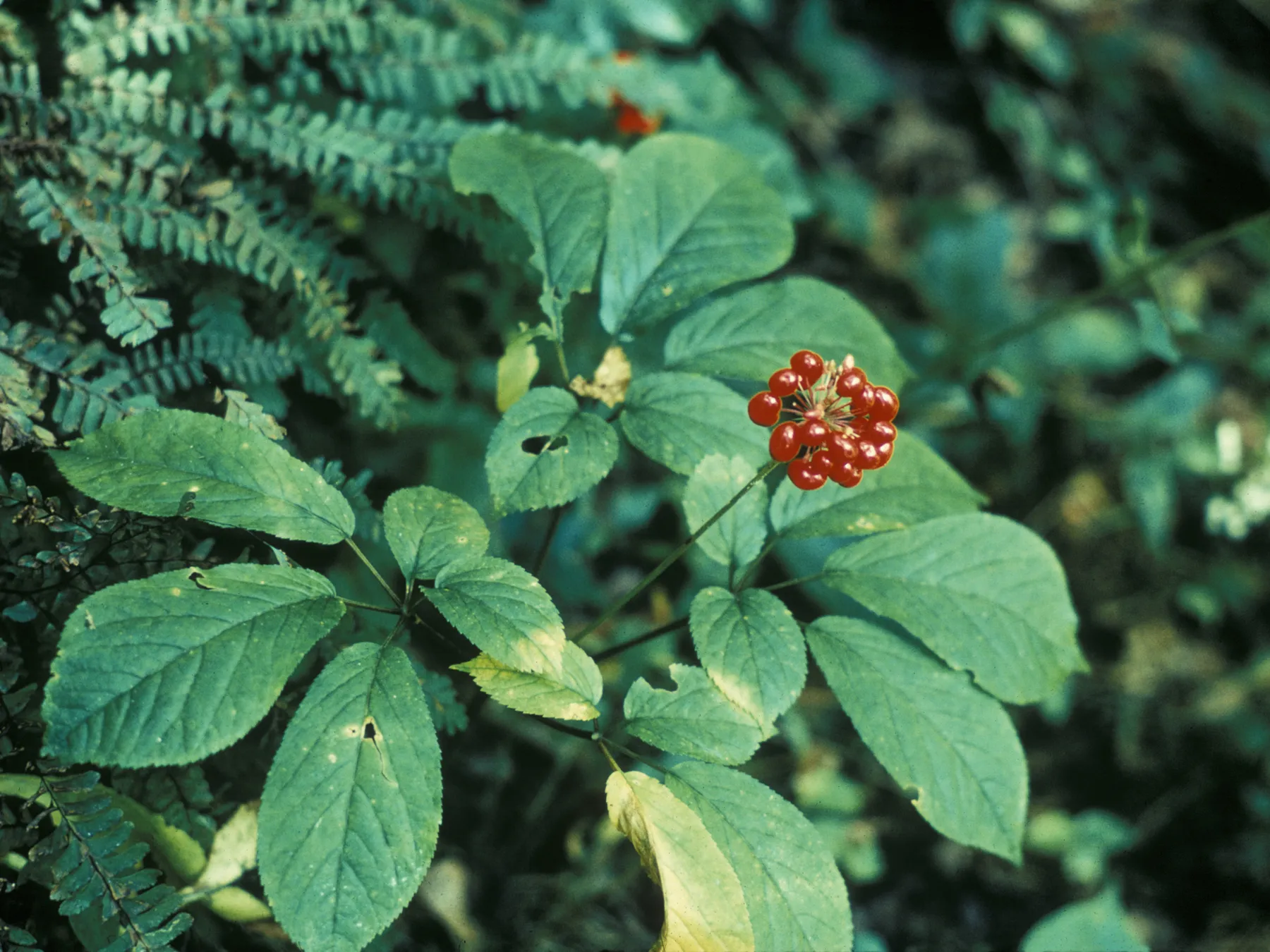
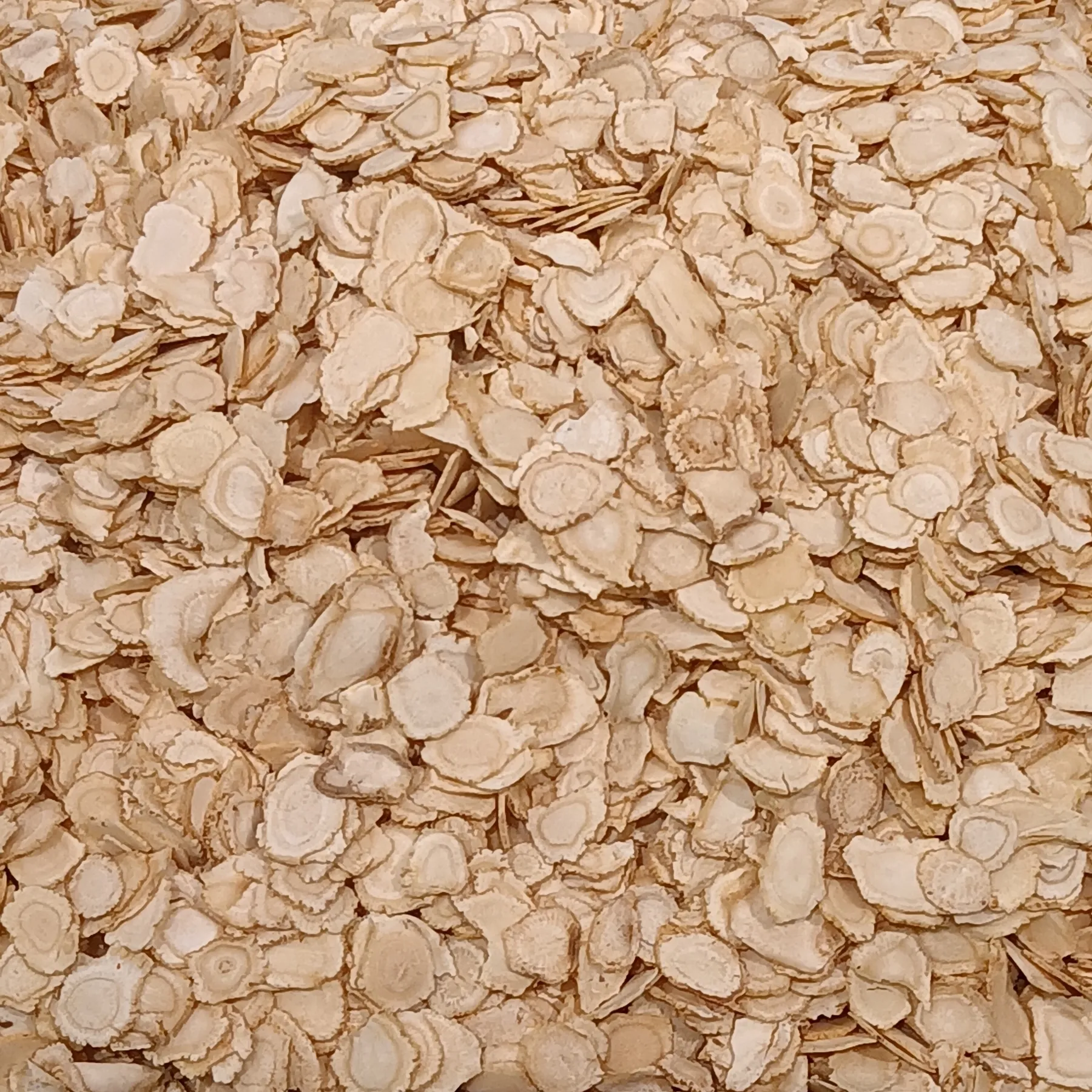
Three plants in the genus Panax account for almost all the ginseng sold in the world: American ginseng (Panax quinquefolius), Korean ginseng (Panax ginseng) and notoginseng (Panax notoginseng). They look alike, they all make ginsenosides, and each one has its own strengths. A lab can tell them apart by their saponin markers (Ji 2023), and the trials behind each one point to different uses. This page is the hub; the pairwise comparisons are American vs Korean ginseng and American ginseng vs notoginseng.
American Ginseng, the Calm One
American ginseng grows wild in the hardwood forests of eastern North America and is farmed in Wisconsin and Ontario. Chinese buyers know it as xi yang shen and class it as cooling. It carries more of the Rb1 family of ginsenosides and less Rg1 than Korean ginseng (Yuan 2026).
Its trials cover four strengths. A 2000 trial of 19 people found 3 grams of root 40 minutes before a sugar drink cut the blood sugar rise by about a fifth (Vuksan 2000). A 2010 trial of 32 young adults found 100 to 400 mg of a standardised extract improved working memory within hours, with higher self rated calmness at 100 mg (Scholey 2010). A 2005 trial of 323 adults found a polysaccharide extract over four months cut colds from 0.93 to 0.68 per person (Predy 2005). A 2013 trial of 364 cancer survivors found 2,000 mg a day for 8 weeks eased tiredness (Barton 2013). Buyers take it for steady focus, a gentler blood sugar curve, fewer winter colds, and energy with a calm edge. The species page is at /wiki/.
Korean Ginseng, the Energising One
Korean ginseng, also called Asian ginseng, grows in Korea and northeast China and is the species behind a deep ginseng research record. Sold white (dried) or red (steamed), it is classed as warming in tradition. A 2026 study found it carries more ginsenoside Rg1 than the American species (Yuan 2026).
Its trials cover fatigue, erectile function and immune response. A 2016 review of 12 studies in 630 people found Korean ginseng eased tiredness better than placebo (Bach 2016). A 2021 Cochrane review of 9 trials in 587 men found it improved erectile function, mostly at 1.8 to 3 grams of red ginseng a day for 8 to 12 weeks (Lee 2021). A 1996 trial of 227 people found an extract taken around a flu shot roughly doubled the antibody response (Scaglione 1996). Two crossover trials found a single 200 to 400 mg dose helped people stay sharper during an hour of demanding mental work (Reay 2005). Buyers want stamina, sexual function and a tonic for low energy. The sister site is at panaxginseng.com.
Notoginseng, the Circulation One
Notoginseng, sanqi or tianqi, grows in the mountains of southwest China, mainly Yunnan. Chinese medicine has long used it for bleeding, bruises, pain and heart and circulation problems (Wang 2016). Air dried notoginseng holds two to five times more total ginsenosides than American or Asian ginseng (Sun 2011), and it is sold raw for bleeding and bruises and steamed as a blood building tonic, a distinction keepers of the tradition have held for a long time.
In a 2023 trial at 67 Chinese hospitals, 3,072 people with ischemic stroke took notoginseng saponin capsules or placebo for 3 months, and 89.3 percent of the saponin group were living independently at 3 months against 82.4 percent on placebo (Wu 2023). A 2023 review of 46 stroke trials in 7,957 people pointed toward the same recovery (Shi 2023). A 2017 review of 1,828 people with angina found fewer attacks (Song 2017), and a 2020 review of 24 trials in 1,918 people with diabetic kidney disease found lower cholesterol (Tang 2020). Buyers keep it for circulation, bruises and recovery, and the sister site at panaxnotoginseng.com follows that same long use.
The Chemistry Explains the Split
A 2004 trial gave 12 healthy adults 3 grams of eight ginseng types, including all three species, before a sugar drink. Where Asian ginseng raised blood sugar, American ginseng tended to lower it, and the ratio of two ginsenoside families was the one measured factor that predicted the response (Sievenpiper 2004). The species name on the label is what tells those plants apart, and American ginseng is the one that tended to lower the after meal rise.
Which One You Want
- Calm focus and after meal blood sugar: American ginseng (Panax quinquefolius). It has the working memory and blood sugar trials, and its extract raised calmness.
- Winter colds and tiredness during cancer treatment: American ginseng again, on the strength of the 323 person cold trial and the 364 person fatigue trial.
- Everyday energy and erectile function: Korean ginseng (Panax ginseng). The fatigue review of 630 people and the Cochrane review of 587 men used this species, and both found a benefit.
- A stronger flu shot response: Korean ginseng, from a 227 person trial that roughly doubled the antibody response.
- Circulation, bruises and recovery: notoginseng (Panax notoginseng). On the strength of a 3,072 person stroke trial, a review of 46 stroke trials, an angina review of 1,828 people and a cholesterol review of 1,918 people (Wu 2023, Shi 2023, Song 2017, Tang 2020), people take it for circulation, bruises and recovery.
What Users Report
People who use more than one species tend to sort them by job. American ginseng gets described as the daytime root: calm, steady, good for desk work. Korean ginseng gets described as the stamina root for training, travel and low energy weeks. Notoginseng gets described as the medicine cabinet root, kept for bruises, circulation and recovery. These reports line up with the trials above, and the American ones keep coming back to a calm, steady day.
Safety Notes
All three species have been tolerated in their trials. Where a 2004 trial of 20 healthy adults found two weeks of American ginseng lowered warfarin's blood thinning effect (Yuan 2004), and where notoginseng acts on platelets, tell your doctor if you take warfarin, antiplatelet drugs, diabetes medicines or MAOIs. Korean ginseng's side effects look similar to placebo in a 2002 review (Coon and Ernst 2002). Across those trials, each species was tolerated at the doses studied.
American ginseng is the species for calm focus, after meal blood sugar, winter colds and tiredness during cancer treatment.
References
- Ji R et al. 2023. Untargeted Metabolomic Analysis and Chemometrics to Identify Potential Marker Compounds for the Chemical Differentiation of Panax ginseng, P. quinquefolius, P. notoginseng, P. japonicus, and P. japonicus var. major. Molecules.
- Yuan M et al. 2026. Multivariate Statistical Evaluation of Ginseng Quality and Antioxidant Activity. Molecules.
- Vuksan V et al. 2000. American ginseng (Panax quinquefolius L) reduces postprandial glycemia in nondiabetic subjects and subjects with type 2 diabetes mellitus. Arch Intern Med.
- Scholey A et al. 2010. Effects of American ginseng (Panax quinquefolius) on neurocognitive function: an acute, randomised, double-blind, placebo-controlled, crossover study. Psychopharmacology (Berl).
- Predy GN et al. 2005. Efficacy of an extract of North American ginseng containing poly-furanosyl-pyranosyl-saccharides for preventing upper respiratory tract infections: a randomized controlled trial. CMAJ.
- Barton DL et al. 2013. Wisconsin Ginseng (Panax quinquefolius) to improve cancer-related fatigue: a randomized, double-blind trial, N07C2. J Natl Cancer Inst.
- Bach HV et al. 2016. Efficacy of ginseng supplements on fatigue and physical performance: a meta-analysis. J Korean Med Sci.
- Lee HW et al. 2021. Ginseng for erectile dysfunction. Cochrane Database Syst Rev.
- Scaglione F et al. 1996. Efficacy and safety of the standardised ginseng extract G115 for potentiating vaccination against the influenza syndrome and protection against the common cold. Drugs Exp Clin Res.
- Reay JL et al. 2005. Single doses of Panax ginseng (G115) reduce blood glucose levels and improve cognitive performance during sustained mental activity. J Psychopharmacol.
- Wang T et al. 2016. Traditional uses, botany, phytochemistry, pharmacology and toxicology of Panax notoginseng (Burk.) F.H. Chen: A review. J Ethnopharmacol.
- Sun S et al. 2011. Red notoginseng: higher ginsenoside content and stronger anticancer potential than Asian and American ginseng. Food Chem.
- Wu L et al. 2023. Efficacy and Safety of Panax notoginseng Saponins in the Treatment of Adults With Ischemic Stroke in China: A Randomized Clinical Trial. JAMA Netw Open.
- Shi X et al. 2023. Efficacy and safety of Panax notoginseng saponins (Xuesaitong) for patients with acute ischemic stroke: a systematic review and meta-analysis of randomized controlled trials. Front Pharmacol.
- Song H et al. 2017. Panax notoginseng Preparations for Unstable Angina Pectoris: A Systematic Review and Meta-Analysis. Phytother Res.
- Tang X et al. 2020. Panax notoginseng preparations as adjuvant therapy for diabetic kidney disease: a systematic review and meta-analysis. Pharm Biol.
- Sievenpiper JL et al. 2004. Decreasing, null and increasing effects of eight popular types of ginseng on acute postprandial glycemic indices in healthy humans: the role of ginsenosides. J Am Coll Nutr.
- Yuan CS et al. 2004. Brief communication: American ginseng reduces warfarin's effect in healthy patients: a randomized, controlled Trial. Ann Intern Med.
- Coon JT, Ernst E. 2002. Panax ginseng: a systematic review of adverse effects and drug interactions. Drug Saf.
Nothing here is medical advice. If you take prescription medication, talk with your doctor before adding American ginseng.